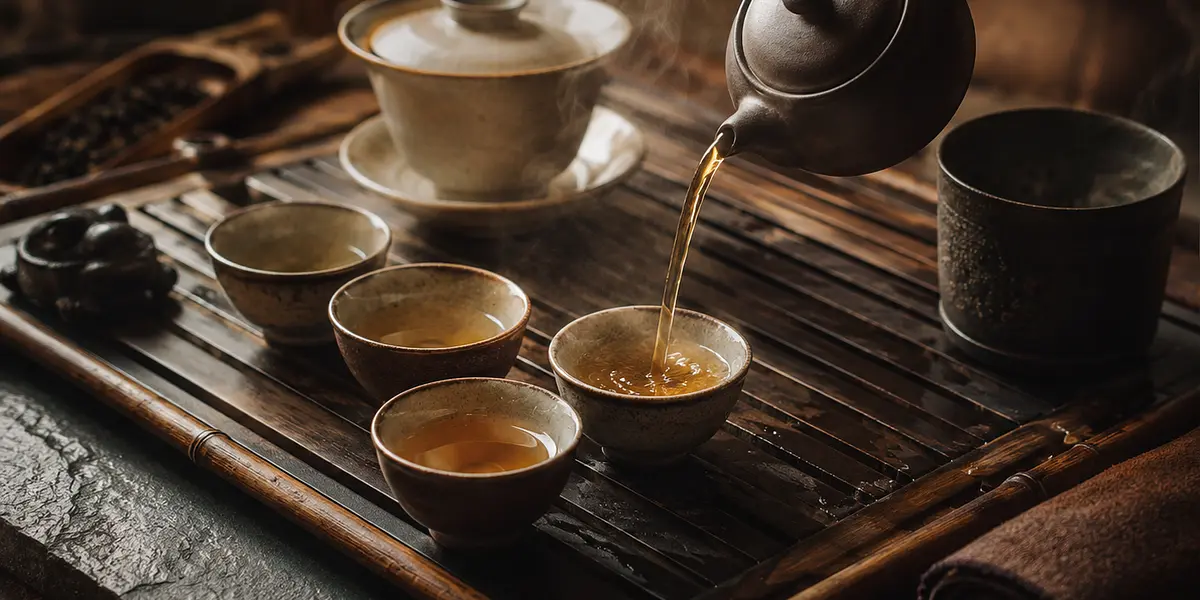
In the West, brewing tea means dropping a bag in a mug and waiting. In China, there is another way — one that has been refined over centuries and turns every session into a slow, sensory meditation. It is called gongfu cha (工夫茶), and once you try it, a teabag will never feel the same.
What Does "Gongfu" Mean?
The word gongfu (also written kung fu) literally means "skill acquired through effort." In martial arts it refers to mastery through practice; in tea it means the same thing. Gongfu cha is not a ceremony in the Japanese sense — there is no codified choreography, no bowing, no matcha whisking. It is simply a method: use a small vessel, a generous amount of leaf, very short steeping times, and brew many rounds. The skill is in the details — water temperature, pour speed, timing — and it develops naturally the more you brew.
The Equipment
Gongfu brewing requires very little, but each piece matters:
- Gaiwan (盖碗) — a lidded bowl, typically 100-150 ml, made of porcelain or ceramic. The gaiwan is the most versatile gongfu vessel: it does not absorb flavour (unlike clay), works with every tea type, and lets you see and smell the leaf up close. If you own only one piece of tea gear, make it a gaiwan.
- Yixing teapot (宜兴紫砂壶) — a small unglazed clay pot from Yixing, Jiangsu. The porous purple clay (zisha) absorbs tea oils over hundreds of sessions and develops a seasoned patina that enhances the brew. Traditionally, a Yixing pot is dedicated to one type of tea — a pu-erh pot, an oolong pot. They are beautiful, collectible, and optional. Start with a gaiwan; graduate to Yixing when you know what you love.
- Fairness cup / Cha Hai (公道杯) — a small glass or ceramic pitcher. After steeping, you pour the tea from the gaiwan into the fairness cup, which ensures every sip from every drinking cup is the same strength.
- Drinking cups — small, typically 30-50 ml. The small size forces you to sip slowly and pay attention.
- Tea tray or tea boat — a surface with drainage, so you can pour freely without worrying about spills. Traditional bamboo trays are beautiful; a simple ceramic plate with a towel works just as well.
- Strainer — a fine-mesh strainer placed on the fairness cup to catch small leaf fragments.
- Tea pick and tongs — a pick to break apart compressed pu-erh cakes, tongs to handle hot cups without burning your fingers.
The Method: How Gongfu Brewing Works
The heart of gongfu cha is high leaf-to-water ratio and short steeping times. Where Western brewing might use 2-3 grams of leaf per 250 ml and steep for three to five minutes, gongfu uses 5-8 grams per 100-150 ml and steeps for as little as five seconds. The result is not a single strong cup but a sequence of cups — each one slightly different as the leaf opens and releases layer after layer of flavour.
A good pu-erh or oolong can give you eight, ten, even fifteen rounds. That is an hour of quiet enjoyment from a single handful of leaf. It is meditative, social (gongfu is best shared), and deeply satisfying.
Step-by-Step Guide
- Heat your water. Boil, then adjust to the right temperature for your tea (see our water temperature guide). For pu-erh and dark oolong, keep it at a full boil.
- Preheat everything. Pour hot water into the gaiwan, fairness cup and drinking cups. Swirl, then discard. This step is not optional — it stabilises the brewing temperature and warms the cups so the tea stays hot longer.
- Add the leaf. Place 5-8 grams (roughly 1 gram per 15-20 ml of vessel capacity) into the gaiwan. Put the lid on and give it a gentle shake — the residual heat will release the dry leaf aroma. Lift the lid and inhale. This is your first introduction to the tea.
- Rinse the leaf (optional but recommended for pu-erh and oolong). Pour hot water over the leaf, let it sit for 3-5 seconds, then immediately pour it all out into the fairness cup and discard. This "awakens" the leaf and rinses away dust from storage or pressing. For green and white tea, skip the rinse — you do not want to waste that precious first infusion.
- First infusion. Pour water over the leaf in a steady, circular motion. Steep for 5-10 seconds — yes, that short. Then pour everything out through the strainer into the fairness cup. From the fairness cup, pour into the drinking cups. Taste. The first steep is often light and aromatic — a whisper of what is to come.
- Subsequent infusions. Add 3-5 seconds to each round. The second and third steeps are often the peak — the leaf is fully open, the extraction is at its richest. By the fifth or sixth round, you might steep for 15-20 seconds. By the eighth, a minute or more. Each round is different: early rounds are bright and aromatic; middle rounds are thick and complex; late rounds are sweet and gentle.
- Know when to stop. When the tea thins out and the flavour fades, the session is over. Spent leaves should be fully unfurled and soft. You can examine them — the condition of spent leaf tells you a lot about the quality of the tea.
Gongfu vs Western Brewing: When to Use Which
Gongfu is not always better — it is different. Here is when each method shines:
- Use gongfu for pu-erh (sheng and shu), roasted oolong, Dan Cong, Wuyi rock tea and aged teas. These are complex teas with many layers, and gongfu's sequential steeping reveals each one. Gongfu is also the way to go when you want to slow down, pay attention and really taste what you are drinking.
- Use Western brewing (large pot, long steep) for simple daily teas, flavoured blends, most green teas (especially Japanese greens) and herbal infusions. Western brewing is convenient, casual and works well when you want a big mug to carry to your desk.
Many teas work with both methods — Tie Guan Yin, for example, is lovely gongfu or Western. The only teas we would not recommend for gongfu are delicate Japanese greens like gyokuro (which have their own specialised method) and CTC-process tea bags (which are designed for one extraction only).
Which Teas Work Best for Gongfu?
In rough order of "most rewarding in gongfu":
- Pu-erh — both sheng and shu. Gongfu is the default method in Yunnan and among pu-erh collectors worldwide. A compressed cake practically demands it.
- Wuyi rock oolong — Da Hong Pao, Rougui, Shui Xian. The mineral yan yun (rock rhyme) unfolds beautifully steep by steep.
- Dan Cong oolong — the fragrance-named oolongs from Chaozhou. Gongfu was essentially invented for Dan Cong.
- Tie Guan Yin — especially traditional roasted versions. The floral-roast duality is stunning in gongfu.
- Aged white tea — Shou Mei and aged Bai Mudan respond well to gongfu, revealing date, honey and medicinal herb notes across many rounds.
- High-quality red (black) tea — Keemun, Jin Jun Mei and Zhengshan Xiaozhong can be revelatory in gongfu, though they also work Western.
Chinese green teas like Longjing can be brewed gongfu in a gaiwan, but the sessions tend to be shorter (four to five rounds) and the leaf is more temperature-sensitive. It is perfectly fine but not where gongfu shows its greatest strength.
Getting Started
You do not need to spend a fortune. A simple porcelain gaiwan (100-120 ml), a glass fairness cup and two small cups will get you started — the whole set can cost less than a bag of good tea. If you are shopping for your first gongfu setup, check our teaware section at Tea 931 for curated starter options.
The real investment is not money — it is attention. Sit down. Boil the water. Warm the cups. Watch the leaf unfurl. Smell the wet lid of the gaiwan (the lid aroma is one of gongfu's secret pleasures). Pour, sip, pour again. After a few sessions, you will understand why the Chinese call this gongfu: skill through effort, mastery through practice, and a deeper relationship with every tea you drink.