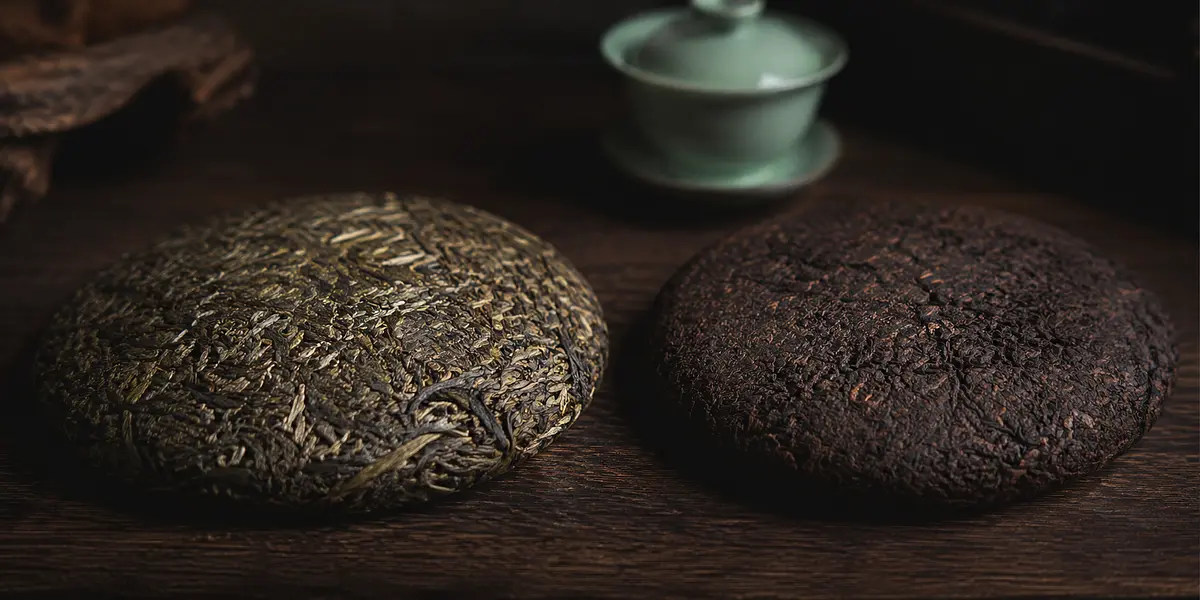
If you've ever browsed a pu-erh shelf — online or in a tea market — you've seen the two words that divide this world in half: sheng (生, raw) and shu (熟, ripe). They come from the same leaf, the same mountains in Yunnan, yet they taste, age and brew so differently they might as well be separate teas. Understanding the difference is the single most useful thing a new pu-erh drinker can learn, and this guide will walk you through it cup by cup.
What Is Sheng (Raw) Pu-Erh?
Sheng pu-erh is the original — the form that has existed for centuries along the Ancient Tea Horse Road. After plucking, the leaves are withered, pan-fired (sha qing) to halt oxidation, rolled and sun-dried. That sun-dried maocha is then steamed and pressed into cakes, bricks or tuos. No accelerated fermentation. No shortcuts. Just leaf, heat, sun and time.
A young sheng is alive with energy. The liquor is pale gold to bright green. On the palate you might get a rush of astringency and bitterness — but behind it, layers of floral sweetness, stone fruit, raw honey, even something vegetal and grassy. The aftertaste (huigan) often arrives in a wave: bitterness transforms to sweetness on the back of the tongue, sometimes lasting minutes. It is this huigan that pu-erh lovers chase.
The real magic of sheng, though, is what happens over years and decades. In proper dry storage, the tea slowly oxidises and microbially transforms. The astringency softens. The bitter green edges round into camphor, aged wood, dried dates, leather and plum. A twenty-year-old dry-stored sheng can be as complex as an aged Burgundy — and just as valuable. This aging potential is what makes sheng pu-erh one of the only teas in the world that collectors buy as an investment.
What Is Shu (Ripe) Pu-Erh?
Shu pu-erh is, by comparison, a modern invention. In 1973, engineers at the Kunming Tea Factory — soon followed by the legendary Menghai Tea Factory — developed a process called wo dui (渥堆), or wet piling. Maocha is piled in heaps, moistened and covered. Over 45 to 60 days, controlled microbial fermentation does in weeks what nature does to sheng over decades. The result is a tea that already has the dark colour, smooth body and earthy depth that people associate with "aged" pu-erh.
Brew a shu and the liquor is deep mahogany to almost black. The aroma is earthy — think wet autumn leaves, dark chocolate, dates, a forest floor after rain. In the cup, a well-made shu is thick and velvety: low astringency, low bitterness, a sweetness reminiscent of dried longan or jujube. The best shu teas have a clean finish with no muddy aftertaste (a sign of good wo dui technique).
Shu pu-erh does improve with a few years of storage — five to ten years rounds off any residual wo dui "pile taste" — but it does not transform as dramatically as sheng. It starts smooth and stays smooth.
Side-by-Side Comparison
| Characteristic | Sheng (Raw) | Shu (Ripe) |
|---|---|---|
| Liquor colour | Pale gold → amber (young → aged) | Deep mahogany to near-black |
| Flavour profile | Floral, bitter-sweet, stone fruit, camphor (aged) | Earthy, chocolate, dates, forest floor |
| Astringency | High when young, softens with age | Low |
| Caffeine | Moderate to high | Moderate (fermentation reduces caffeine) |
| Aging potential | Decades — improves dramatically | 5-10 years — subtle refinement |
| Price entry point | Moderate (young) to very high (aged/gushu) | Affordable to moderate |
| Best for beginners? | Challenging — bitterness can surprise | Very approachable |
Flavour: What Will You Actually Taste?
Pour a young sheng and a shu side by side and the contrast is obvious before you even sip. The sheng is light and luminous in the cup; the shu is opaque and dark. Smell the sheng and you might catch honey, wildflowers, a hint of green bean. Smell the shu and you get earth, cocoa, dried fruit.
The first sip of sheng can be confrontational — a bright bitterness that grabs the front of the tongue. Give it a moment. That bitterness converts to sweetness; the tea fills the throat with a cooling, almost menthol sensation the Chinese call cha qi. Shu, by contrast, is immediately comforting: thick, warm, low-key. It is the cashmere sweater of the tea world.
As sheng ages — say ten years of clean dry storage — it moves towards the shu profile while retaining an elegance and liveliness that shu rarely achieves. This is why serious collectors buy young sheng and wait.
Which One Is for You?
Ask yourself a few questions:
- Do you like bold, complex flavours? Start with sheng. The bitterness is part of the experience, and huigan is worth the journey.
- Do you want something smooth and comforting right now? Shu is your tea. No waiting, no acquired-taste learning curve.
- Are you interested in aging tea? Buy sheng. A good cake stored well will reward you year after year.
- Are you sensitive to caffeine? Shu is gentler — the fermentation process lowers caffeine content slightly.
- Budget-conscious? Shu offers outstanding value. Entry-level shu cakes give you a satisfying, full-bodied cup at a fraction of the price of aged sheng.
Our honest advice: try both. At Tea 931 we carry sheng from bright young gushu cakes to ten-year dry-stored classics, and shu from everyday Dayi recipes to refined aged ripes. Grab one of each, brew them gongfu-style in a gaiwan, and let your palate decide. The beauty of pu-erh is that there is no wrong answer — only the next cup.
How to Get Started
If you are completely new, consider a mini cake (100 g) or a sample set. A 100 g sheng like our Jin Xiao Ya lets you explore without committing to a full 357 g bing, while a benchmark shu like the Dayi 7572 gives you the reference point every shu lover should know. Brew with fully boiling water (95-100 °C), use about 7-8 grams per 100 ml, and steep short — five to ten seconds for the first infusion, adding a few seconds each round. Pu-erh reveals itself slowly over many steeps, and that gradual unfolding is half the pleasure.
Welcome to the world of pu-erh. Whichever side of the sheng-shu divide you land on, you are in for a remarkable journey.