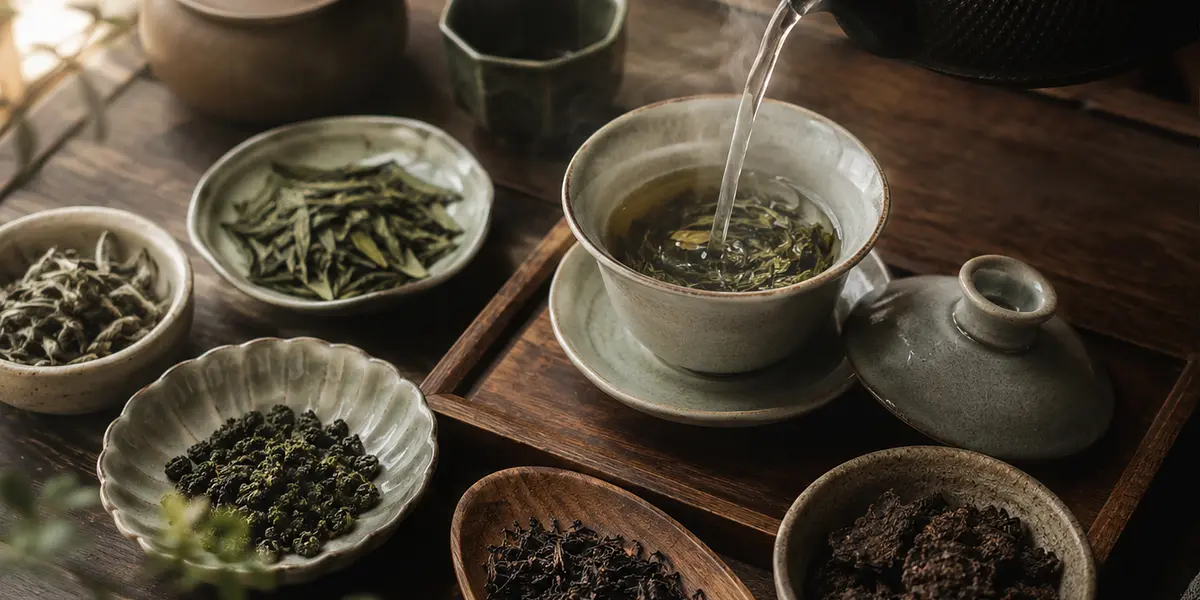
There is one variable that matters more than any other when you brew tea — and it is not the leaf, the teapot or the steeping time. It is the temperature of the water. Get it right and a modest tea can taste wonderful. Get it wrong and even the finest Longjing will turn bitter, flat or astringent. The good news: the rules are simple, and once you memorise the basics you will brew better tea every single day.
Why Temperature Matters: The Science
Tea leaves contain hundreds of compounds, but three groups dominate the flavour of your cup:
- Catechins (polyphenols) — responsible for bitterness and astringency. They dissolve faster at higher temperatures.
- Amino acids (especially L-theanine) — responsible for sweetness, umami and body. They dissolve readily even at lower temperatures.
- Volatile aromatics — the fragrance in the cup. Higher temperatures release more aromatics but also drive some away faster.
The art of temperature is about balance. For a delicate green tea packed with amino acids, lower water preserves sweetness while keeping bitter catechins in check. For a fully oxidised black tea or a compressed pu-erh cake, you need near-boiling water to crack open the leaf structure and extract that deep, rich body.
The Temperature Chart
Here is your cheat sheet. Pin it to the fridge, save it on your phone — it will serve you for years.
| Tea Type | Temperature | Notes |
|---|---|---|
| Green tea (Chinese) | 75-80 °C / 167-176 °F | Pan-fired greens like Longjing tolerate the upper end; steamed greens stay lower. |
| Green tea (Japanese sencha) | 70-80 °C / 158-176 °F | High-grade sencha benefits from cooler water. Lower temp = more umami, less bitterness. |
| Gyokuro | 50-60 °C / 122-140 °F | The coolest of all. This shade-grown tea is extremely rich in amino acids — low temp extracts pure umami. |
| Matcha | 70-80 °C / 158-176 °F | Whisk with water just off the boil that has cooled for a minute or two. |
| White tea | 80-85 °C / 176-185 °F | White tea is forgiving. Slightly hotter than green, but never a full boil. |
| Yellow tea | 80-85 °C / 176-185 °F | Similar to white — gentle heat preserves the mellow character. |
| Oolong (light / floral) | 85-90 °C / 185-194 °F | Tie Guan Yin and high-mountain Taiwan oolongs open beautifully at 85-90 °C. |
| Oolong (roasted / dark) | 90-95 °C / 194-203 °F | Da Hong Pao, Rougui and other Wuyi rock oolongs need heat to release mineral depth. |
| Red / Black tea | 90-100 °C / 194-212 °F | Most black teas want a full or near-full boil. Delicate Keemun can go slightly cooler. |
| Pu-erh (sheng & shu) | 95-100 °C / 203-212 °F | Compressed cakes need the highest heat to open up. Always boiling for shu; sheng can occasionally go to 90 °C for very young cakes. |
| Herbal / tisane | 100 °C / 212 °F | Full boil — these are not true tea leaves, so there is no catechin bitterness to worry about. |
What Water to Use
Temperature is only half the equation — the water itself matters enormously. Here are the rules:
- Filtered tap water is the everyday best choice. A simple carbon filter removes chlorine and off-flavours while keeping enough minerals for good extraction.
- Spring water with a low-to-moderate mineral content (TDS 50-150 ppm) is the gold standard for tea competitions and tastings.
- Avoid distilled or reverse-osmosis water — it is too "empty." Without minerals, extraction is weak and the tea tastes flat.
- Avoid hard water (TDS above 300 ppm). Heavy mineral content mutes aroma and leaves a chalky mouthfeel.
- Never re-boil. Reboiled water loses dissolved oxygen and produces a duller cup. Start fresh each time.
Common Mistakes (and How to Fix Them)
Mistake 1: Boiling water on green tea. This is the number-one tea crime. Boiling water extracts catechins so aggressively that even the finest Dragon Well becomes a bitter, astringent mess. Let your kettle cool to 75-80 °C before pouring. If you don't have a thermometer, boil and wait roughly two minutes.
Mistake 2: Lukewarm water on pu-erh. Pu-erh, especially compressed cakes, needs heat to open up. Water at 80 °C barely unfurls the leaves. Use a rolling boil — 95-100 °C. This extracts the deep, rich body that makes pu-erh so satisfying. At Tea 931, we always brew our pu-erh cakes with fully boiling water and recommend you do the same.
Mistake 3: Not preheating the vessel. Pour hot water into a cold ceramic gaiwan and the temperature drops 5-10 °C instantly. Always preheat by swirling a splash of hot water around the vessel and discarding it. This is especially important for pu-erh and dark oolong where every degree counts.
Mistake 4: Guessing the temperature. Our eyes are terrible thermometers. "Tiny bubbles" is not 80 °C — it is closer to 70 °C. Invest in a variable-temperature electric kettle (the single best tea accessory you can buy) or use an instant-read kitchen thermometer until you build intuition.
Mistake 5: Ignoring altitude. Water boils at a lower temperature at higher altitudes. If you live above 1,500 metres, your "boiling" water may only be 95 °C. For pu-erh and black tea, consider keeping the kettle on a rolling boil and pouring while it is still bubbling.
Equipment Tips
You do not need expensive gear to control temperature, but a few tools make it effortless:
- Variable-temperature electric kettle: The gold standard. Set your target (80 °C for green, 95 °C for pu-erh) and let it hold. Fellow, Bonavita and Brewista all make excellent models.
- Instant-read thermometer: Cheap and effective. Dip it in the kettle or the cup to check.
- Glass or porcelain fairness cup: If you are doing gongfu brewing, pour the boiled water into a glass pitcher first — it will drop roughly 5-8 °C in 30 seconds, which can be enough for oolong or white tea.
A Simple Rule of Thumb
If you forget everything else, remember this: the more oxidised or compressed the tea, the hotter the water. Green and white sit at the bottom (75-85 °C). Oolong lives in the middle (85-95 °C). Black, pu-erh and herbal teas want a full boil (95-100 °C). Follow this gradient and you will never ruin a cup.
Better water temperature is the simplest, cheapest, most dramatic upgrade to your tea experience. Try it today — pick one tea from your shelf, look up its ideal temperature in the chart above, and brew it with intention. The difference will speak for itself.